
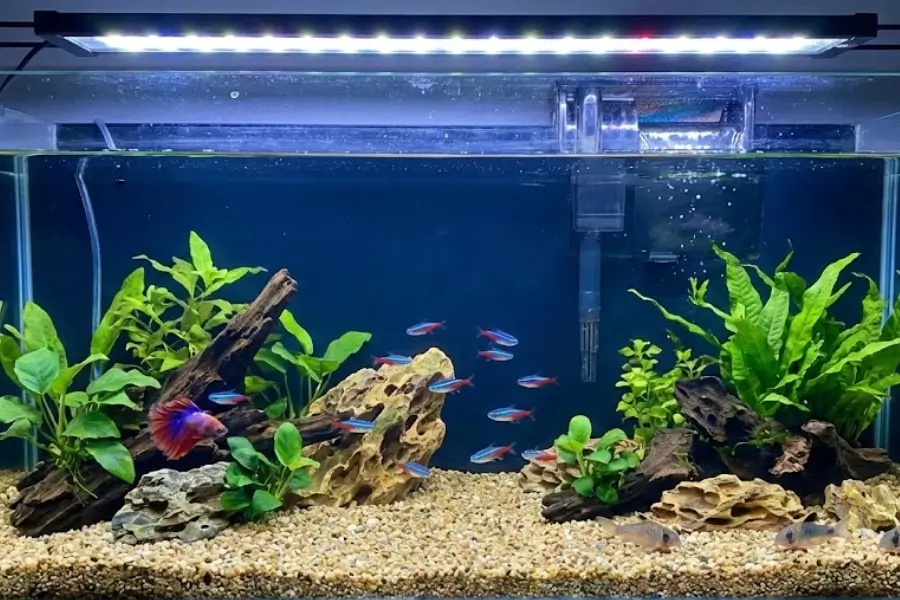
Most first aquariums fail for one reason, and it is not the fish or the equipment. It is adding fish before the tank is ready to keep them alive.
Everything else here is straightforward. Get the order right and a first tank is genuinely easy.
Planning
- Freshwater to start. Cheaper, simpler, and far more forgiving of the mistakes everyone makes early on.
- Bigger is easier, which is the opposite of what people expect. A large volume of water changes chemistry slowly, so a mistake is something you notice and correct rather than something that kills fish overnight. A 20 gallon long is an excellent first tank. Avoid anything under 10 gallons.
- Position it out of direct sunlight, or you will be fighting algae and temperature swings forever. Near a socket, because the filter, heater and light all need one. On something genuinely sturdy and level, since a filled 20 gallon weighs over 200 pounds.
What you need
- A filter. The heart of the tank, and the home for the bacteria that keep it safe. A hang-on-back filter is the easiest to live with.
- A submersible heater. Most beginner tropical fish want a steady 75 to 80F.
- Substrate, gravel or sand, in a natural colour. It houses bacteria and anchors plants.
- An LED light, essential if you want live plants and useful regardless.
- Water conditioner. Tap water contains chlorine and chloramine and both kill fish. This is not optional.
- A thermometer, a net, and a siphon for water changes.
- Decor. Rocks, driftwood and plants, for hiding places as much as looks.
- A liquid test kit. Skip this and you are cycling blind.
Setting it up
- Rinse the tank, substrate and decorations in plain water. Never soap. Residue is toxic and does not fully rinse away.
- Position the tank and check it is level.
- Add 2 to 3 inches of substrate, sloped slightly toward the back if you want depth.
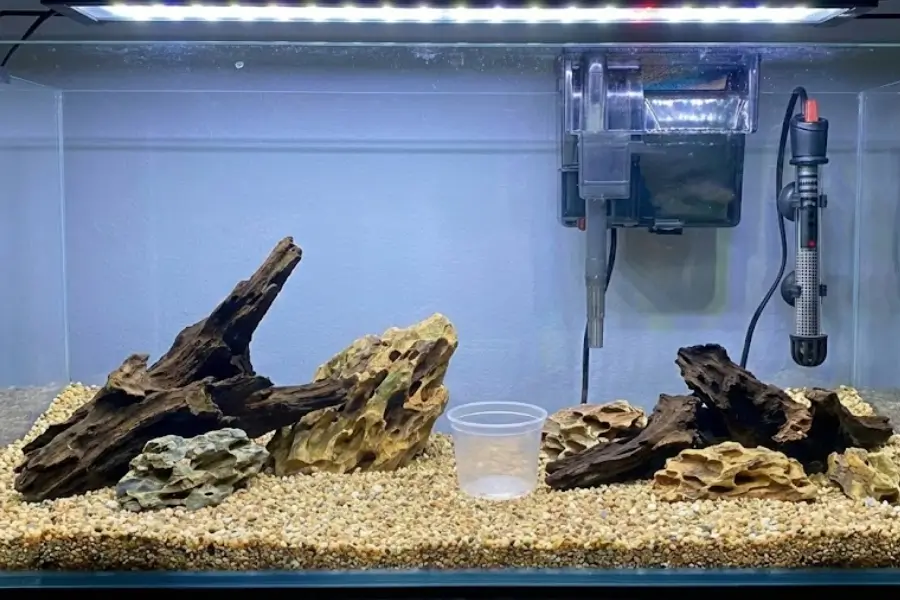
- Fit the filter and heater but leave them unplugged.
- Arrange the hardscape. Build caves and hiding places, because fish with cover are visible fish. Fish without it hide.
- Lay a plate or bag on the substrate and fill slowly over it so you do not excavate what you just arranged.
- Add conditioner at the dose for the full volume.
- Now switch everything on, with the heater fully submerged before it gets power.
The nitrogen cycle, which is the whole thing
Fish produce ammonia, which is toxic. A tank needs a bacterial colony to convert ammonia to nitrite, and nitrite to far less harmful nitrate. Until that colony exists, the tank poisons anything you put in it.
This takes four to six weeks and there is no honest shortcut.
- Cycle without fish. Add a pinch of fish food daily as an ammonia source and let the bacteria build on that. Doing it with fish in means the fish absorb the damage.
- Test as you go. You want ammonia at 0, nitrite at 0, and a nitrate reading of roughly 10 to 40 ppm. That combination means it is done.
- Do not rush it. Adding fish early is new tank syndrome, and the fish are poisoned by their own waste while you watch.
Adding fish
- Three or four small fish at a time, then wait a couple of weeks. The bacteria colony grows to match the waste, and it needs time to catch up.
- Start with hardy species: small tetras such as neons or embers, harlequin rasboras, corydoras catfish for the bottom, or a single betta with suitable tank mates.
- Acclimatise properly. Float the sealed bag for 15 to 20 minutes to match temperature, then add small amounts of tank water to the bag over another 15 to 20 minutes. Net the fish out into the tank and pour the bag water down the sink, never into the tank.
Keeping it running
- Daily: feed only what they clear in two or three minutes, check the temperature, and look at the fish properly. Behaviour changes before anything visible does.
- Weekly: a 10 to 20 percent water change, vacuuming the substrate as you siphon, refilled with conditioned water at the same temperature.
- Monthly: rinse the filter sponges in the old tank water you just removed. Never under the tap, because chlorine kills the bacteria living in them and effectively un-cycles your tank. Replace cartridges only when they are falling apart.
Overfeeding is the most common ongoing mistake and the cause of most cloudy water and algae. Fish are very good at looking hungry, and it means nothing.












0 Comments