

You pick up your keys and the dog changes. The pacing starts, the whining starts, and you leave the house knowing what the next three hours look like for them.
Separation anxiety is not a dog being naughty or dramatic. It is closer to a panic attack, and it responds to treatment. Slowly, and not to the things most people try first.
Where it comes from
Rarely one cause. Usually a combination.
- A change of routine. A house move, a new work pattern, or the loss of a person or another pet in the household.
- A rescue background. A dog that has been rehomed more than once has evidence that people leave and do not come back.
- Never having learned to be alone. A puppy that was never gradually left has no reason to believe that being alone ends.
- Constant company, which sounds like the opposite of a problem and sets up the same dependency.
- Breed and genetics. Some lines are simply more anxious.
Is it anxiety or boredom
This matters, because the treatments are different and the wrong one wastes months.
The distinguishing feature is that anxiety symptoms are tied specifically to being alone or to the signs that you are about to leave. A bored dog chews the most interesting thing in the house. An anxious dog chews the door.
- Destruction focused on exits: door frames, window sills, the furniture nearest the way out.
- Howling, barking or whining that continues the whole time you are gone.
- Soiling indoors by a dog that is reliably house-trained.
- Pacing a fixed route, unable to settle at all.
- Heavy panting and drooling.
- Digging or chewing at doors, windows or a crate in an attempt to get out.
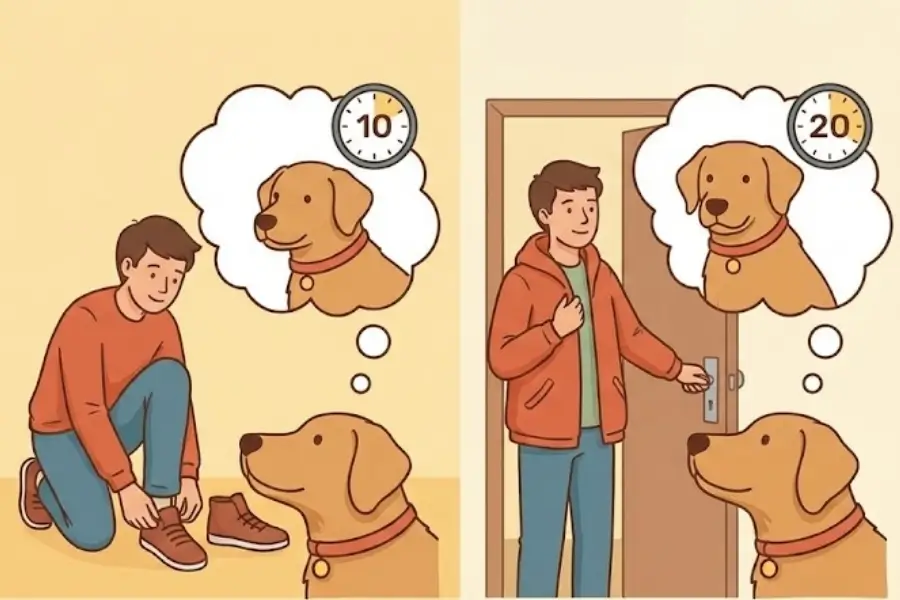
- Distress that starts while you are still putting your shoes on.
What actually works
Stop the rehearsal first
This is the step people skip and it is the one the rest depends on. Every hour the dog spends alone and panicking makes the next one worse. Until training takes hold, do not leave them alone longer than they can cope with. Daycare, a sitter, a neighbour, taking them with you. Whatever is needed to break the cycle.
Take the meaning out of the cues
Pick up your keys and sit down. Put your shoes on and make a cup of tea. Do it dozens of times until those actions stop predicting anything.
Build the time up from nothing
Graduated departures means genuinely graduated. Out of the door and back in after one second. Then five. Then thirty. You move up only when the dog is calm at the current step, and if a session goes wrong you go back a stage rather than pushing through.
Make coming and going boring
No emotional goodbyes and no reunion at the door. Come in, put your things down, and greet the dog a few minutes later when they have settled. It feels unkind and it is the fastest way to teach a dog that your leaving is not an event.
Tire them out properly
Walks, puzzle feeders, training sessions. A dog whose brain has had a workout has a lower baseline to start from, and mental work tires a dog faster than distance does.
Ask about medication in severe cases
There is no virtue in refusing it. A dog in genuine panic cannot learn anything, and anti-anxiety medication from your vet lowers the baseline enough for the training to have somewhere to land. It is a tool that makes the behaviour work possible, not a replacement for it.
What not to do
- Never punish any of it. The behaviour is fear, and punishment adds to the fear while teaching the dog to dread your return as well.
- Do not get a second dog to keep them company. This is about you specifically, and the usual result is two dogs where there was one problem.
- Do not crate a dog with confinement anxiety. They will injure themselves trying to get out, and dogs regularly do.
Realistically
This takes months and the progress is not linear. There will be a week that goes backwards for no reason you can name.
It is also genuinely one of the harder things to live with as an owner, because it limits your life as well as the dog’s. If you are getting nowhere after a couple of months, a certified behaviourist working alongside your vet is worth the money. This is a condition where professional help changes the outcome rather than just speeding it up.












0 Comments