

A cat who paws food onto the floor before eating it is usually read as fussy. Quite often it is a cat solving a problem with the bowl.
Whisker fatigue is not a made-up complaint, and it is one of the cheapest things in cat care to fix. Understanding it starts with understanding what whiskers actually are.
Whiskers are not decoration
Properly called vibrissae, they are sensory organs. Each one sits in a follicle packed with nerves and blood vessels, which makes them extremely fine touch receptors rather than stiff hairs.
- They judge gaps, which is how a cat knows whether it fits through something before trying.
- They read air movement and vibration, which is how a cat tracks prey in the dark.
- They feed into balance and spatial awareness.
- They broadcast mood. Forward means interested, flat against the face means frightened or angry.
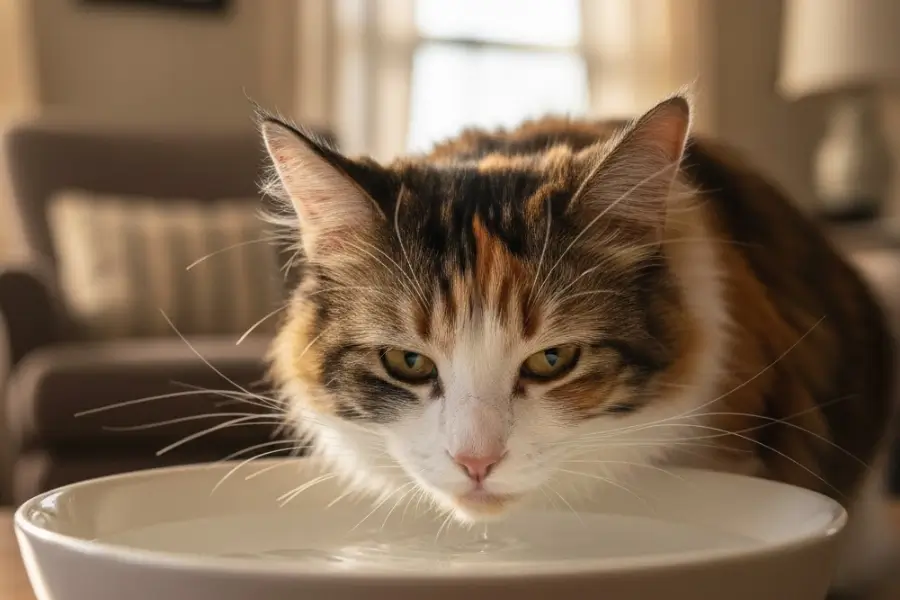
What the fatigue actually is
Whiskers are built to report light contact as meaningful information. Bend them repeatedly and the signal becomes constant, and constant input from a sensitive organ stops being information and starts being irritation.
A deep narrow bowl does exactly this at every meal. The cat pushes its face in, both sets of whiskers drag along the sides, and it keeps happening until the food is gone.
What it looks like
- Approaching the bowl, hesitating, and eating only from the middle while leaving a ring of food round the edge.
- Scooping food out with a paw and eating it off the floor.
- Tilting the head at odd angles, or eating from the side of the mouth.
- Pawing at or striking the bowl.
- Seeming stressed at mealtimes while clearly being hungry.
- The same hesitation at a deep water bowl, which often shows up as a cat that drinks less than it should.
The fix
- Wide and shallow, which is the whole answer. The rim needs to be far enough apart that the whiskers never touch it, and shallow enough that the face is not buried.
- Ceramic, stainless steel or glass rather than plastic. Plastic scratches, holds bacteria in the scratches, and is associated with chin acne in some cats.
- Raised bowls suit older or arthritic cats by taking strain off the neck, as long as they are still wide and shallow. Height is not a substitute for width.
While you are at it
- Keep bowls genuinely clean. Old food residue puts cats off and gets blamed on fussiness too.
- Offer water in more than one place. Many cats prefer moving water, so a fountain is worth trying, and any standing bowl should be whisker-friendly as well.
- In a multi-cat house, one bowl each, spaced apart. Eating next to another cat is its own source of stress and it looks identical from the outside.
If the bowl swap makes no difference within a week or two, the fussiness is about something else and is worth a vet check. Dental pain and nausea both look very like this.












0 Comments