
A rescue bird that flinches from your hand is not being difficult. It is telling you something accurate about what hands have meant so far.
This is fixable, and the method is slower than almost anyone expects going in. What follows is the order that works, and the reason each step comes where it does.
Why hands specifically
To a bird, a hand is a large object coming toward it from above, which in the wild has one meaning. That instinct is already there before anything happens to them.
A rescue bird usually has something on top of it: being grabbed, handled roughly, or simply never socialised at all. You are not teaching a new thing so much as overwriting an old one, and that only happens at the bird’s pace. Push and you confirm what it already believes.
First, make the cage feel safe
- A cage big enough to move around properly. Cramped increases stress and removes the option of getting away from you, which is the option the bird most needs to have.
- Put it where the household happens but the chaos does not. A corner of a living room is usually right.
- Feed, clean and visit at roughly the same times each day. Predictability does a surprising amount of the work here.
Second, be present without reaching
The first stage involves no contact at all. You are proving that your presence is not the start of something.
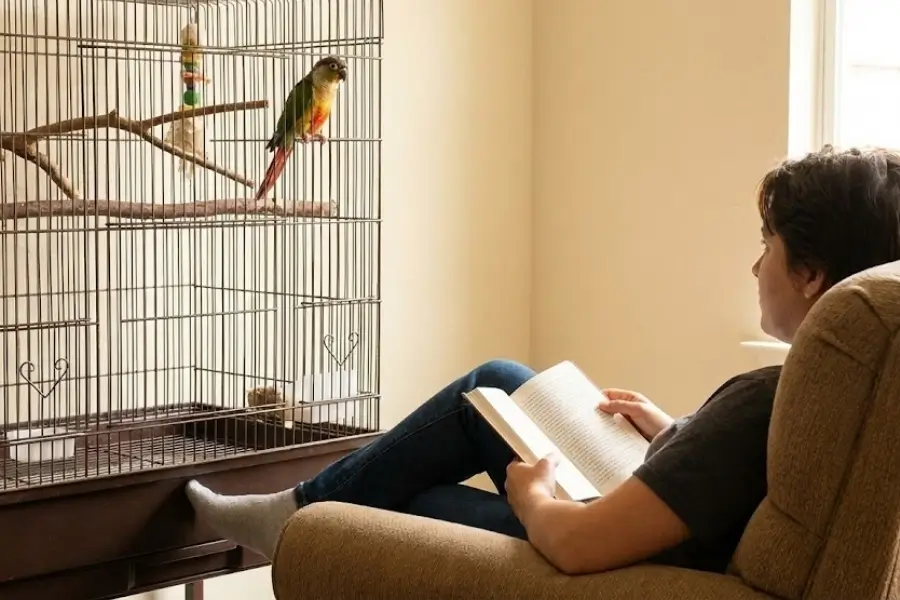
- Sit near the cage and do something else. Read, work, watch television, and talk to them quietly while you do it.
- Learn the body language. Feathers slicked tight and eyes wide means frightened. Slightly fluffed, and beak grinding, means comfortable. Work only when you are seeing the second one.
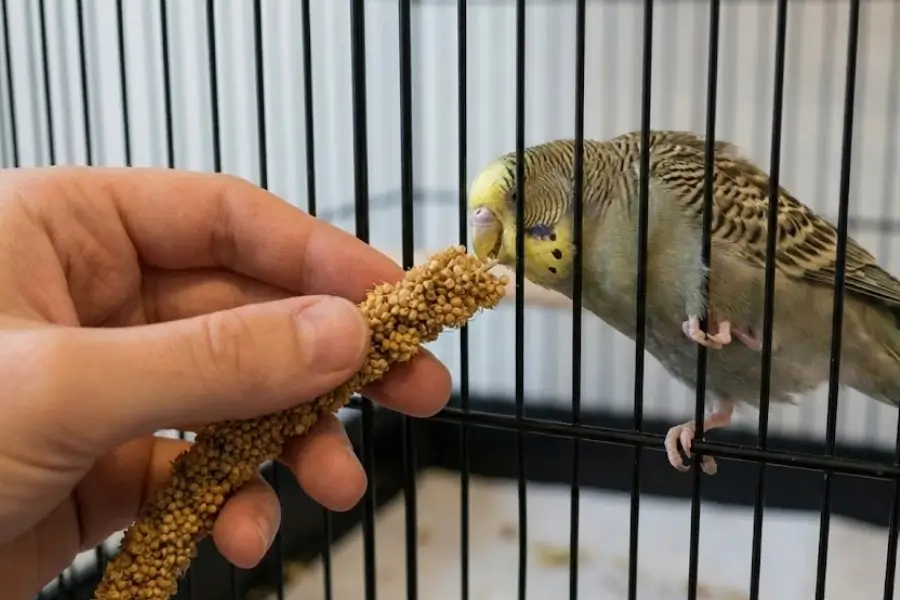
- Find the treat they cannot resist, usually millet or a particular fruit, and offer it through the bars so the cage is still between you.
Third, let your hand exist
- Rest your hand on the outside of the cage, well away from the bird, for a few minutes at a time.
- When that is boring to them, open the door and rest your hand just inside on a low perch, holding a treat. Do not move toward the bird. Let approaching be their decision every time.
- Change food and water slowly and deliberately. Sudden movements undo several sessions.
Fourth, target training
This is the step that changes things fastest, and it is entirely hands-off. You teach the bird to touch a chopstick for a reward.
- Hold the stick near them. The moment they look at it, praise and treat.
- Wait for a beak to touch it, then reward immediately.
- Use the stick to guide them around the cage, and eventually toward your hand.
The point is that it moves the focus onto a neutral object and gives the bird a way to earn things by choosing to act. A bird with some control over the situation is a far braver bird.
Fifth, and last, the step up
- Offer a handheld perch rather than your hand and guide them onto it with the target stick. A stick is much less alarming than fingers.
- When the perch is routine, offer a flat steady hand with a high value treat on it.
- If they lean away, take the hand back. Never follow a bird that is retreating. Go back a step and try again another day.
The realistic timeline
There will be days that go backwards for no reason you can identify, and a week where nothing changes at all. That is the normal shape of this, not a sign you are doing it wrong.
Count the small things. A bird that took a treat today and would not yesterday has moved. The relationship you end up with is unusually solid, because every part of it was the bird’s choice.












0 Comments