
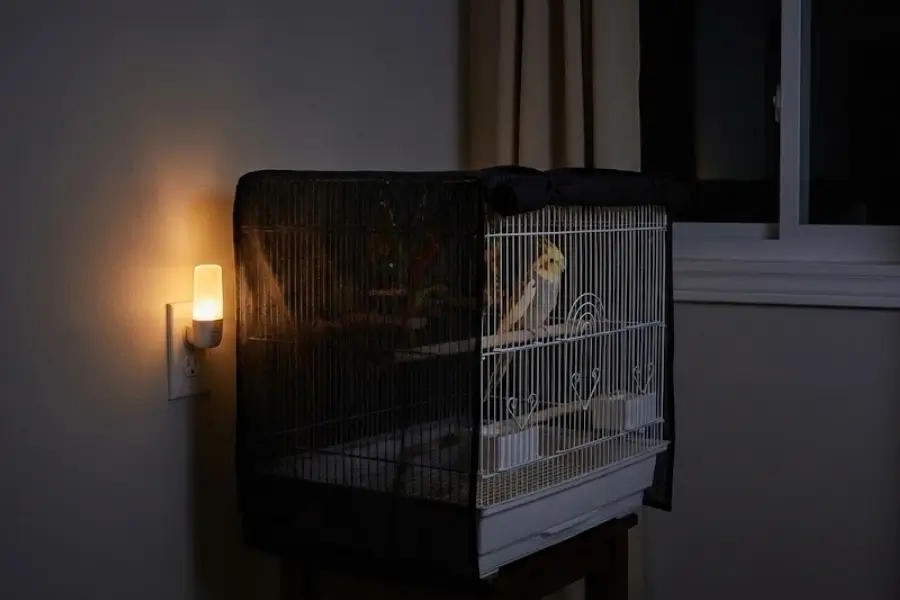
The worry that stops most flat-dwellers getting a bird is the neighbour, and it is a fair worry. It is also aimed at the wrong target, because the gap between a cockatoo and a budgie is not a matter of degree.
No bird is silent. What varies enormously is whether the noise is a whistle you stop noticing or a call designed to carry across a valley. Here are the species that fall on the right side of that line.
What quiet actually means here
Every bird uses its voice to locate its flock and say how it feels. In a flat, you want one whose repertoire is chirps, whistles and low chatter, and whose contact call is not the main event.
A bird that screams for ten minutes each time you leave the room will end the arrangement. One that warbles to itself while dismantling a toy will never be mentioned by anyone through the wall.
Budgerigar
The most popular flat bird in the world, and deservedly. Budgies chatter almost continuously, but the voice itself is tiny, a warbling grinding sound most people find pleasant background noise.
They are bright, sociable, and quite capable of learning speech, and even a talking budgie is unlikely to carry through a wall. They need real time outside the cage, but their size makes everything else about them easy in a small home.
Cockatiel
Bigger than a budgie and still mild. Males in particular are outstanding whistlers, and many learn whole tunes or copy the microwave.
The everyday sound is whistles and chirps. They will let out a proper flock call if they lose sight of you, which is loud but brief, and the usual cure is being in the room rather than the next one. They bond hard and are often happy to sit on a shoulder for an hour doing very little.
Bourke’s parrot
The quietest option on this list by some margin. Soft pink and grey, calm to the point of being undemanding, and most active at dawn and dusk when they make a gentle tinkling sound.
The rest of the day they are close to silent. They are not a cuddly bird and they will not learn to talk, so this is a bird to watch rather than handle. If the wall you share is a thin one, this is the safe choice.
Pacific parrotlet
Tiny, bold and rather full of themselves. They behave like a large parrot scaled down, which is entertaining, and they simply do not have the lung capacity to produce the volume their cousins manage.
What you get is quick sharp chirps and quiet chatter. They are busy birds who want puzzles and things to destroy, and a genuinely enriching cage for one fits in a corner.
Pionus
If you want a proper medium-sized parrot, this is the family to look at. A blue-headed or Maximilian Pionus is markedly quieter than a conure, a grey or anything in the macaw direction.
They are somewhat reserved and independent, and the important part is that they do not scream for attention. Startle one and it will make a noise, but it does not use volume as a tool. They need a big cage and a bigger commitment than a budgie, and they are the best large parrot for a flat.
Keeping it quiet whatever you choose
- Heavy curtains or acoustic panels on the shared wall do more than people expect.
- A bored bird is a loud bird. Shreddable toys and foraging puzzles are noise control, not luxuries.
- Keep light and sleep on a consistent schedule. Most screaming traces back to stress or a disrupted routine.
- Do not come running when they scream. Arriving is the reward, and a bird works out that connection in about three days.
One last thing worth doing: spend time with the actual bird before you commit. Species tells you the range, and the individual tells you where in it you have landed.












0 Comments