
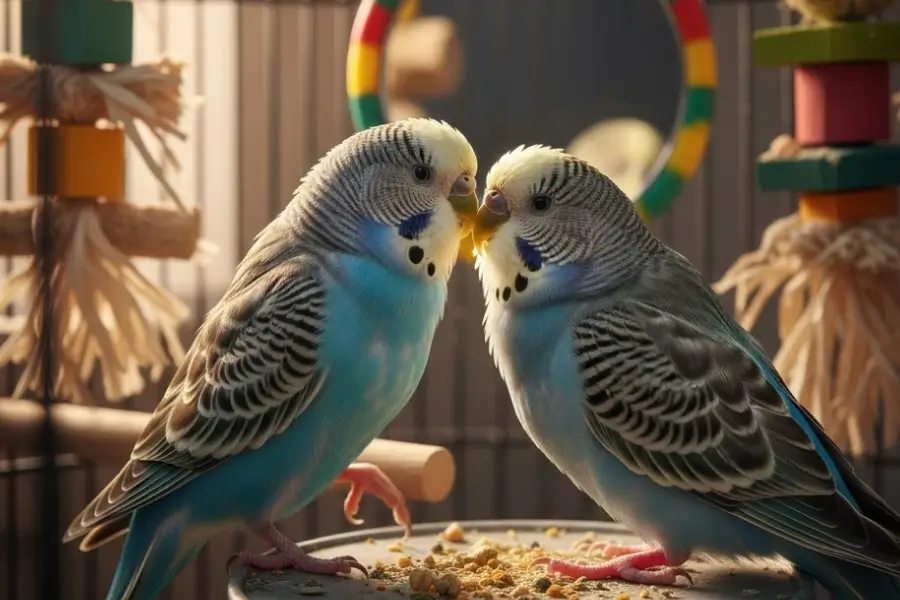
A budgie chattering at its own reflection looks like the happiest thing in the room. It is usually the opposite, and avian vets are close to unanimous about it.
The problem is not the mirror itself. It is that a parakeet cannot tell it is a reflection, and everything that follows comes from that one fact.
What a parakeet needs from company
Budgerigars are flock birds. In the wild they live in large groups, preening one another, sharing food, and keeping up a constant back and forth of sound and posture. That exchange is where a parakeet’s sense of safety comes from.
A bird kept on its own has none of it, and it will look for a flock mate in whatever is available. The mirror is what it finds.
Why the mirror bird is worse than nobody
It answers just enough to be convincing and never enough to satisfy.
- Nothing comes back. It does not preen in return, does not share food, does not respond to any of the signals the bird is sending.
- So the bird escalates. It courts, it displays, it tries harder, and the lack of response turns into persistent anxiety rather than boredom.
- Hormones follow the behaviour. Males become territorial and aggressive, and many regurgitate for the reflection to the point of crop problems and genuine malnutrition. Females can be pushed into chronic nesting and repeated egg-laying, which is hard on the body and shortens their life considerably.
- You get shut out. A bird bonded to a mirror has less reason to bond with you.
What it looks like when it has gone too far
- Constant chattering, calling or screaming at the mirror.
- Lunging, biting or hissing when you come near the cage.
- Regurgitating onto the mirror or the perch beside it.
- Guarding it, so you cannot clean that part of the cage.
- Pacing in front of it, or repetitive head bobbing.
- Ignoring every other toy in the cage.
- In bad cases, plucking feathers out.
What to do instead
The mirror is standing in for something real, so the answer is to supply the real thing.
- A second parakeet is the proper fix. Two birds sort each other out in ways no owner can replicate.
- If that is not possible, you become the flock. Talk, sing, sit near the cage, hand treats. It needs to be daily to count.
- Rotate toys made of wood, paper and natural fibre, and add foraging toys so food takes some working out.
- Showers, music, and supervised time out of the cage in a bird-proofed room.
Taking it away
Remove the mirror. Expect a few unsettled days, because from the bird’s point of view a companion has disappeared, and that is a real loss to it even though the companion never existed.
Fill the gap at the same time rather than afterwards. More attention, new things to chew and pull apart, and if you can manage it, another bird. Within a week or two most birds are visibly better company than they were, because they are no longer spending the day arguing with glass.












0 Comments