
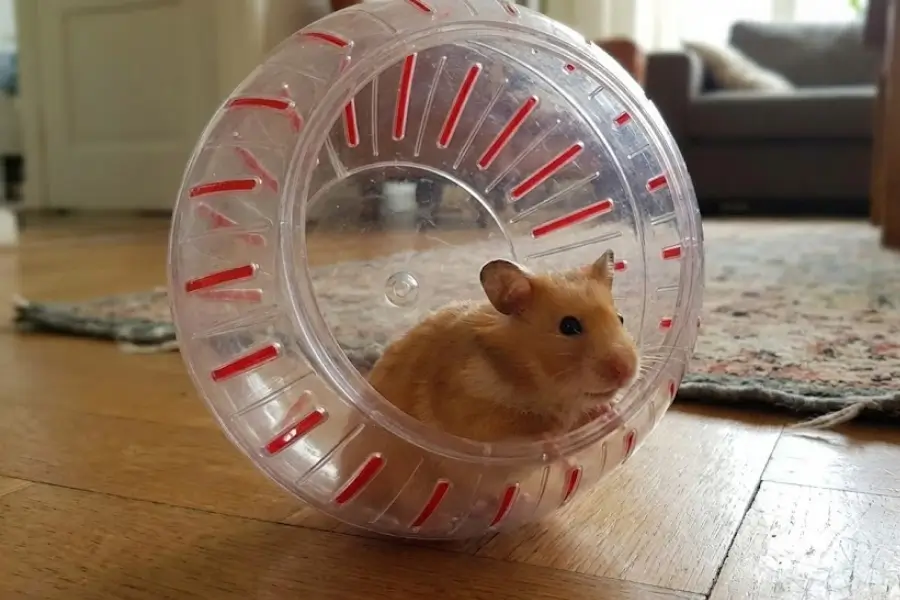
The plastic exercise ball has been sold alongside hamsters for so long that it reads as standard equipment rather than a choice. It looks like the obvious answer to a small animal in a big house.
Exotic vets and welfare organisations have been steadily moving away from it, and the reasoning is worth understanding, because it is not squeamishness. It comes down to what the ball does to an animal that navigates by whiskers and scent.
The injuries the ventilation slits cause
The slits that let air in are also gaps that move. As the ball turns, a toe or a nail can catch in one, and the animal’s own momentum does the rest.
- Toes and nails get caught and pulled, which can mean a torn nail, a sprain, or a break.
- The injuries happen quietly, inside a moving ball, and are often noticed only afterwards.
Why they run into things
A hamster reads the world through its whiskers and its nose. Both are sealed off inside a plastic sphere, so the animal is effectively navigating blind at speed.
That is why they hit skirting boards and chair legs. It is not clumsiness, and it is not enthusiasm. There is no information reaching them about what is ahead, and the running is often less exploration than a reaction to being unable to stop.
The part that looks like fun and may not be
A wheel in a cage can be left at any moment. A ball cannot. The animal cannot stop when it is tired, cannot reach water, and cannot get back to anywhere that feels safe.
- Hamsters are prey animals, and open floor with no cover is the worst place they can be.
- A clear ball in the middle of a room offers exposure with no retreat.
- Some will urinate or defecate out of fear, then keep rolling through it.
What reads as a happy sprint is, quite often, an attempt to get out.
Heat and air
A sealed plastic sphere with a small warm mammal inside behaves like a miniature greenhouse. Hamsters overheat fast, and heatstroke in an animal that size is not something you get time to fix.
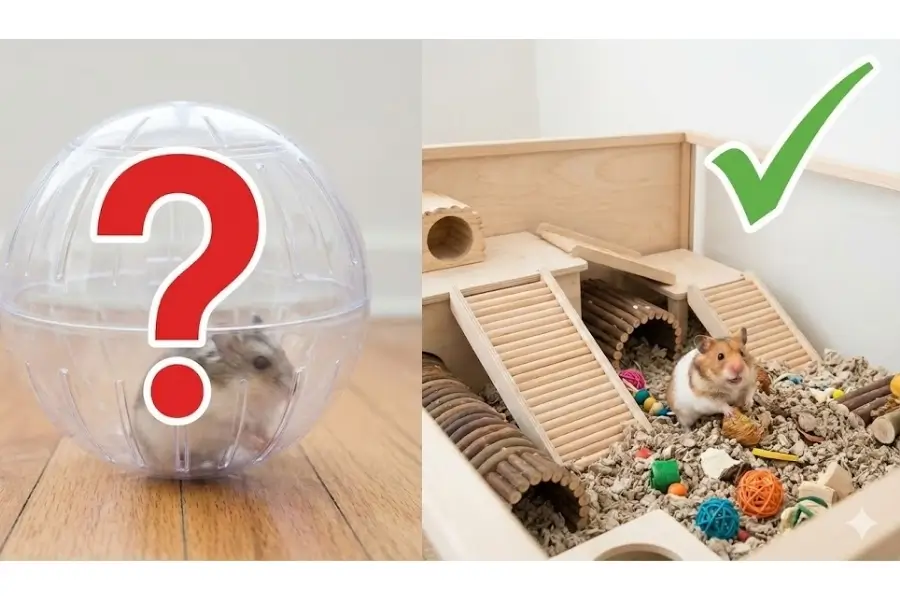
Ammonia is the other half of it. In a space that small, urine builds a concentration quickly, and hamster airways are sensitive to it. Neither problem is visible from outside the ball.
What to do instead
None of this means keeping a hamster shut in its cage. It means giving the time out in a form where the animal still has its senses and a way to retreat.
- A foldable playpen with a solid floor, filled with hideouts, tunnels and safe things to chew. They explore properly because they can smell and feel where they are going.
- A small hamster-proofed room, a bathroom being the usual choice, with every gap blocked off first.
- Sitting on the floor and letting them climb over you. Slower, and the thing that actually builds a tame hamster.
The short version
The ball is convenient for the person and disorienting for the animal, and the convenience is the only argument in its favour. A playpen takes two minutes longer to set up and gives a hamster an evening it can actually use.
If you already own one, you have not harmed your hamster by using it. Put it away, set up a pen, and watch the difference in how the animal moves when it can feel the floor.












0 Comments