
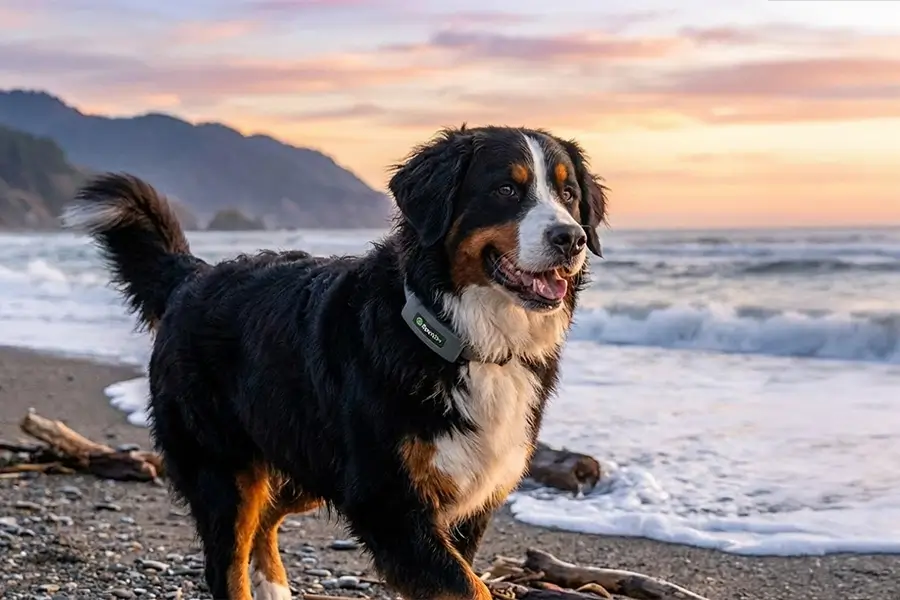


Wire fences break, wooden fences cost more than the dog did, and neither is an option on land that runs to acres or falls away into woodland.
The SpotOn GPS Fence replaces both with a collar and a satellite fix. It is expensive enough to think hard about, so the questions worth answering are how accurate it really is and what happens to it if you stop paying.
Accuracy, which is the whole product
The failure mode that ruins cheap GPS collars is drift. The boundary wanders, the dog gets corrected for standing where it stood yesterday, and the dog learns that the collar is arbitrary. Once that happens the system is finished.
SpotOn works four satellite networks at once rather than one, which is what holds the boundary to roughly three feet under open sky. There is a dedicated mode for heavy tree cover as well. No GPS is truly reliable under a thick canopy, but this holds up better than most, and that is the environment where the others fall apart.
Drawing the fence
You can walk the perimeter with the collar in hand and drop the boundary where you actually want it, or draw it on a map in the app. Walking is slower and worth it wherever the line matters, along a stream or a real property edge.

You can save around twenty fences and switch between them, which is the feature that earns its keep if you travel or spend time at a relative’s place. You can also place keep-out zones inside the main boundary, for a pond, a road edge, or the one flower bed you would rather keep. It scales from half an acre to properties large enough that a physical fence was never a real option.
The subscription question, answered properly
Containment does not need a subscription. You buy the hardware, and the fencing, the custom boundaries and the tree-cover mode keep working without a monthly bill. Several well-known competitors turn into an ornament the month you stop paying, so this is a real difference rather than marketing.
What the optional plan buys is live tracking on a cellular connection, so that if the dog does get out you can follow them on a map instead of driving around calling. It also logs where they spend their time. If containment is all you want, you can genuinely skip it.
Wearing it and charging it
It is rated IP67, so swimming, rain and mud are fine, and it comes in sizes covering necks from about ten to twenty six inches. It is bulkier than a nylon collar, which is noticeable on a smaller dog.
Battery runs roughly twenty five hours with tracking on, longer in containment only, so this becomes a thing you charge nightly like a phone. The charging clip is proprietary, which is a small design irritation and a large practical one if it goes missing.
Who it suits
This is for acreage, awkward terrain, or a property that cannot be physically fenced. On a small suburban plot a real fence is cheaper, simpler and does not need charging.
If you have the land, this is the most accurate system of its kind and the only major one that still contains your dog after you stop paying. Those two things together are what you are buying.



0 Comments