
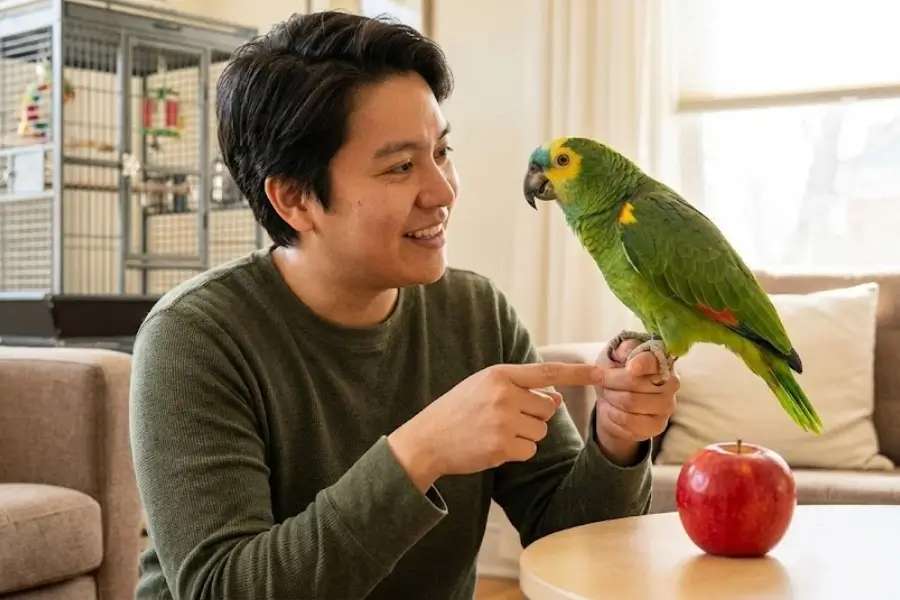
Mimicry is one of the more remarkable things parrots do, and teaching it is genuinely good for them. It is mental work, it is attention, and it gives a bird a way of getting a response from you.
Some birds talk readily and some never will, and that is largely down to species and individual temperament rather than anything you did. What technique changes is how far a bird gets with what it has.
Setting up to learn
- Pick the right time. Early morning and late afternoon tend to work best, when a bird is alert but settled. Training a tired or overexcited bird achieves nothing.
- Kill the background noise. No television, no music. Your voice needs to be the most interesting sound in the room.
- Keep sessions to five or ten minutes and do several a day. Frequency beats length by a wide margin, and a bird stops attending long before you notice.
How to say it
- Slowly, clearly, and the same way every time. Same tone, same rhythm, same emphasis. A word said three different ways is three different sounds to a bird.
- Use an animated, higher-pitched voice. Birds are drawn to emotional, high tones, which is why so many first pick up the voices of women and children in the house.
- Give it context. Say bye-bye as you put your coat on, every time. Say good night as the cover goes over. A sound attached to an event sticks far better than a sound repeated at nothing.
- Start with short words, two syllables, or the bird’s own name. Better still, take a chirp or whistle your bird already makes and pair a word to it, so you are building from something it can already produce.
Rewarding it
Positive reinforcement is the whole method. Never tell a bird off for the noises it makes or for failing to talk, because the only lesson available there is that vocalising near you is risky.
- Reward the attempt. A syllable, or even the right rhythm with the wrong sounds, gets the treat immediately. Waiting for the finished word means the bird never finds out it is on the right track.
- Be deliberate about what earns attention. Screaming gets no look, no word, no reaction at all, and the moment it stops or turns into something else, you respond. Birds work this out quickly, and most screaming problems are built accidentally this way.
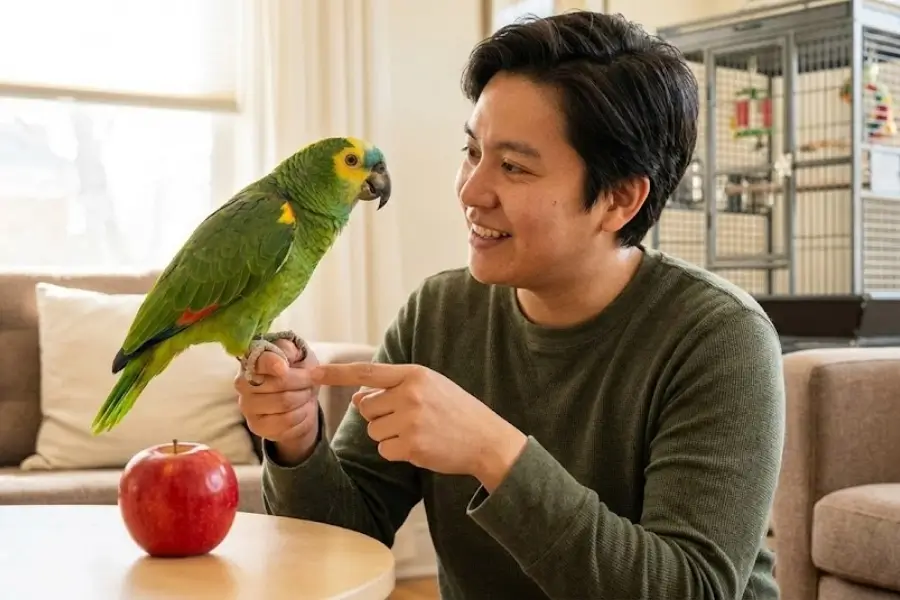
- The rival technique works well for some parrots. Two people: one says the word to the bird, the other says it back and is loudly rewarded for it. The bird watches somebody else getting the thing it wants and joins in. It feels silly and it is surprisingly effective.
Tools, and one to be careful with
- Recordings. Your own voice repeating the target words, played while you are out, gives clear repetition without wearing you out. Keep it short and on a timer rather than running all day.
- Mirrors. Some birds vocalise more at a reflection, and it is worth knowing that this carries a real risk. A bird can bond to its own reflection, which causes frustration, hormonal behaviour and in some cases obsessive regurgitating and aggression. Budgerigars in particular are prone to it.
If you use a mirror at all, use it for short supervised sessions and take it away afterwards. It should never live in the cage as a permanent companion.
What to expect
Months, not weeks, and long flat stretches where nothing happens. Then a bird says something in the middle of the night that you have not deliberately taught it.
That is worth knowing in advance: birds pick up whatever is said with feeling and repetition, not whatever is on your list. Be a little careful what you say around them when something falls on your foot.












0 Comments