
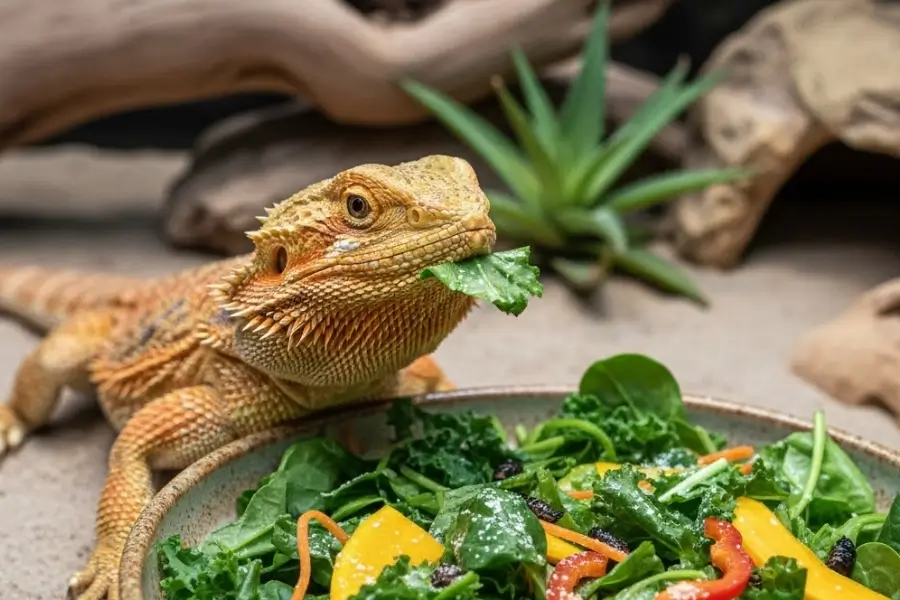
Bearded dragons are omnivores whose requirements invert as they grow. A hatchling is mostly eating insects. An adult should be mostly eating salad, and a great many pet dragons never make that switch because nobody told their owner it was supposed to happen.
Here is what goes in the bowl, what stays out of it, and the two habits that matter more than the shopping list.
Greens, which are most of an adult’s diet
Roughly eighty percent of an adult dragon’s food should be fresh greens and vegetables. That is where the fibre, the vitamins and above all the calcium come from.
Variety matters, because no single green covers everything.
- Collard greens. The best staple available, high in calcium with a good calcium to phosphorus ratio.
- Mustard greens. Rich in vitamins A, C and K, and most dragons like them.
- Turnip greens. Very high in calcium.
- Dandelion greens, from a shop or from a lawn you know has had nothing sprayed on it.
- Escarole and endive, safe daily and useful for rotating the menu.
Vegetables worth adding
- Butternut squash, high in fibre and vitamin A, good enough to use as a staple.
- Bell peppers in red, orange or yellow. Good vitamin C, and the colour gets their attention.
- Green beans, chopped small.
- Carrot in small amounts only. The vitamin A adds up faster than people expect.
Two things to keep out. Iceberg lettuce is water with a crunch and displaces food that would have done something. Spinach and beet greens are worse than useless in quantity, because the oxalates in them bind calcium and stop your dragon absorbing it.
Insects, and the rule that prevents an emergency
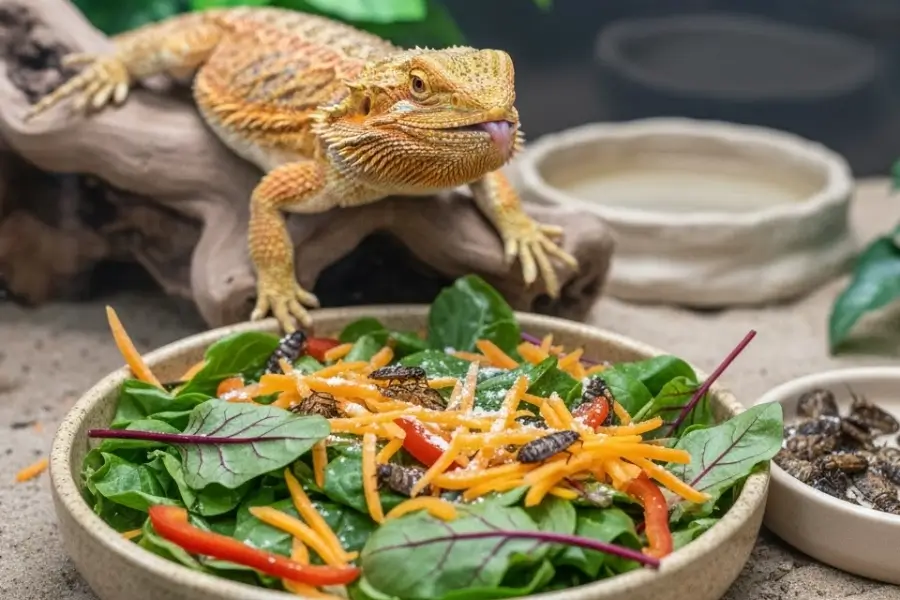
Insects are the protein and the entertainment. The rule that matters is size: nothing wider than the space between your dragon’s eyes. Larger than that risks choking or impaction, and impaction is a vet visit at best.
Staples
- Dubia roaches. The standard for good reason. High in protein, low in shell, and they neither jump nor climb smooth walls.
- Crickets. Nutritious and they bring out hunting behaviour. They are also noisy and they escape.
- Black soldier fly larvae, sold as Phoenix worms or NutriGrubs, and naturally high in calcium.
Occasional only
- Mealworms. A tough shell that younger dragons digest poorly.
- Superworms. Fatty, fine now and then.
- Waxworms. Essentially butter. Useful for putting weight on a thin dragon and nothing else.
- Hornworms. Mostly moisture, which makes them good for hydration and poor as a protein source.
The two habits that do the heavy lifting
Dust the insects with a calcium supplement several times a week. Captive diets rarely hit calcium levels on their own, and metabolic bone disease is the price of finding that out slowly.
Gut-load the insects as well. Feed the bugs good vegetables for a day before they go in. Whatever is inside the insect goes straight into your dragon, so a well fed cricket is a considerably better meal than a starved one, at no extra cost.
Water and timing
Most of their water comes out of the greens, but put out a shallow dish anyway and mist the salad. Some dragons drink readily and some seem never to, and you cannot tell which you have until you offer.
Feed the salad in the morning. Digestion in a reptile runs on heat, so a dragon needs the day under its basking lamp to process the meal. Food going in late sits in a cooling animal, which is how a good diet still ends up causing problems.












0 Comments