
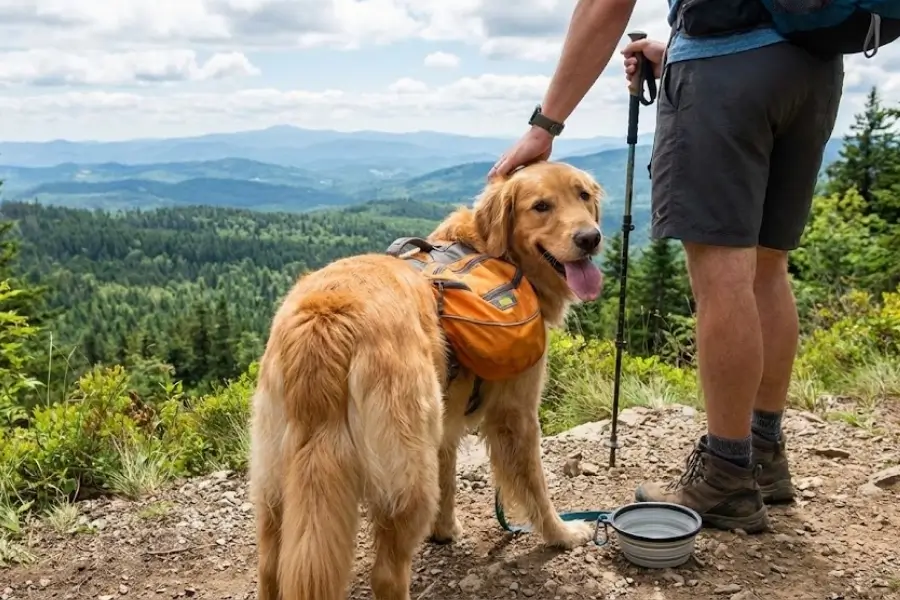
A dog makes an excellent hiking companion, right up until the point where you find yourself carrying one down a mountain because the ground was hotter than you thought.
Most of what goes wrong on a trail is preventable at home. Here is the preparation, the kit, and the handful of things that actually cause trouble out there.
Before you go
Check with your vet
Worth doing before anything strenuous. They will tell you whether the dog’s age, build and joints suit the kind of walking you have in mind. Puppies still growing and older dogs with joint problems are both poor candidates for long or rough routes, however keen they are.
Get vaccinations current, including leptospirosis, and make sure flea, tick and heartworm prevention is up to date. All three matter more outdoors.
Build them up
A dog that walks around the block is not ready for a mountain, and they will not tell you they are struggling until they are. Add distance and difficulty over several weeks. Conditioning prevents injuries and it is the difference between a dog that enjoys the day and one that endures it.
Check the trail allows dogs
Many do not. National Parks are often restrictive, National Forest and BLM land generally less so. Look up leash rules, terrain, whether there is water on the route, and what wildlife is around.
What to pack
Essential
- Water and a collapsible bowl. Reckon on at least 8 ounces per dog per hour, and more when it is warm. Do not rely on streams being there.
- A sturdy fixed-length lead, and a harness rather than a collar. Retractable leads fail at exactly the wrong moment near a drop.
- Poo bags, more than you expect to need. Leave no trace applies to dogs.
- Food and high-calorie treats. Hiking burns through a dog faster than you would think.
Worth having
- A dog pack, if the dog is a healthy adult. Keep the load under 15 to 25 percent of body weight, and load it evenly.
- Boots or paw wax. Hot rock, sharp scree, ice and grit all damage pads. Boots protect best and need practice at home first, because most dogs walk very strangely in them to begin with.
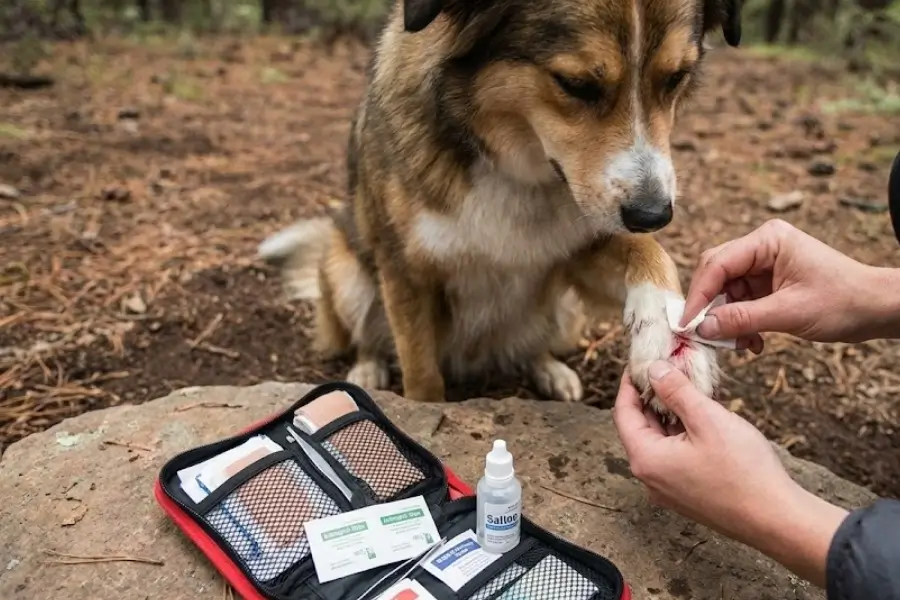
- A canine first aid kit, containing antiseptic wipes, gauze and self-adhering bandage, tweezers for ticks and thorns, blunt-nosed scissors, a pet-safe antihistamine with a dose confirmed by your vet, styptic powder for a torn nail, and a small emergency blanket.
On the trail
Heat is the real risk
Dogs cool themselves by panting and through their pads, and that is far less effective than sweating. Walk early or late, break often, and get water into them and onto them.
Learn what overheating looks like: heavy frantic panting, thick drool, bright red gums, unsteadiness. That is an emergency, not a rest stop. Get them into shade and water immediately and head for a vet.
Check the ground with the back of your hand. If you cannot hold it there for seven seconds, it is too hot for paws.
Etiquette
You are representing every dog owner on that trail. Yield to walkers coming uphill, keep your dog close, and with horses step well off the path and keep the dog quiet and still until they have passed. Horses spook, and a spooked horse on a narrow path is dangerous for everyone.
Wildlife
Keep the lead on. A dog that chases something gets lost, gets hurt, or brings the thing back to you, and all three happen. Know what is in the area, whether that is snakes, bears or mountain lions, and what you are supposed to do about it.
Check them over at the car
Ticks, cuts and burns on the pads, and anything caught in the coat. Foxtails and grass seeds are the ones to hunt for, because they work inward and end up as an expensive problem a week later.
The short version
Condition the dog, carry more water than you think, watch the temperature, and keep the lead on. That covers nearly everything that goes wrong.
Get it right and you have a companion who is better company on a mountain than most people, and who will sleep for a day and a half afterwards.












0 Comments