
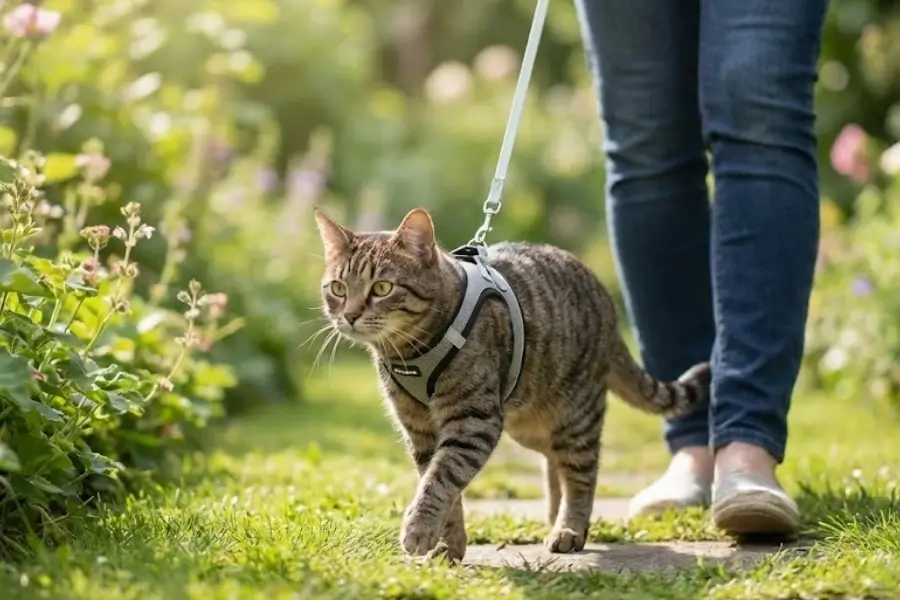
A cat on a lead sounds like a party trick. It is closer to a controlled way of letting an indoor cat have the outside world, and plenty of cats take to it.
The training is slower than dog training and the order matters a great deal. Done in the wrong order you get a frightened cat who will not look at a harness again.
Why bother
- Enrichment. Outdoor smells and sounds are the richest sensory input a cat can get, and boredom is behind a good deal of indoor cat behaviour.
- Exercise, which matters for an indoor cat’s weight and joints.
- Safety. All the outdoors, none of the traffic, fights or disappearances.
- It is a genuinely good thing to do together, and cats notice the attention.
The equipment, and the rule that matters
Never clip a lead to a collar. A cat’s throat is delicate and a sudden pull can do real damage. This is not a caution, it is the reason cat harnesses exist.
- A harness of the vest or jacket type, which spreads pressure across the body and is much harder to reverse out of. Measure the cat and buy the right size. Snug, with room for two fingers underneath.
- A light fixed-length lead, four to six feet. Not a retractable one. They fail, they allow a cat to get too far away too fast, and the cord tangles around things.
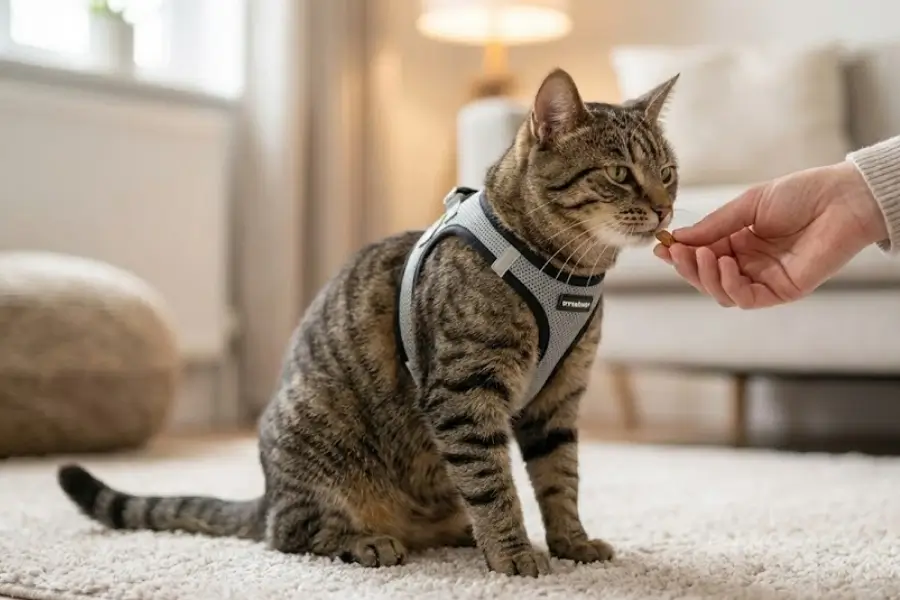
Introducing the harness, which is most of the work
Do not put it on and go outside. That single shortcut is what ruins most attempts.
- Leave it out where the cat spends time and let them investigate it in their own time. Put a few treats near it.
- When it is boring, drape it over their back for a few seconds and give a treat. If that is fine, fasten it.
- Expect one of two reactions the first time it is done up: flopping over sideways as though paralysed, or trying hard to reverse out. Both are normal. Distract immediately with a high value treat or a favourite toy.
- Keep sessions to a couple of minutes and always finish while it is still going well.
Adding the lead
- Clip it on and let them drag it around indoors so they get used to the weight behind them. Watch that it does not catch on furniture.
- Then pick up the end and simply follow wherever they go. No tension at all.
- Only once that is comfortable, start guiding. Lure with a treat and use the lightest possible pressure, and reward every time they move with you rather than against you.
The first time outside
- Pick somewhere quiet and enclosed. A garden or a patio, not a park and not a street.
- Carry them out rather than letting them walk through the door. Otherwise you are teaching a cat that the open door is an invitation, which is the opposite of what you want.
- Put them down and let them set the pace. Most cats crouch, stare and sniff for a long time before moving, and that is a normal first outing.
- If something spooks them, pick them up. Never pull the lead on a panicking cat.
Things to keep in mind
- Some cats manage this in a week and some take months. Neither is a verdict on the cat.
- Rewards only. Any telling off attaches itself to the harness and undoes the work.
- Stay alert outside for dogs, sudden noise and anything that might send the cat up a tree while attached to you.
- Some cats will never enjoy it. Persistent fear rather than caution is a no, and it is worth accepting rather than pushing through.
When it works, it is unmistakable. A cat with its tail up, actively pulling toward the next interesting smell, having a far better afternoon than the windowsill was ever going to provide.












0 Comments