
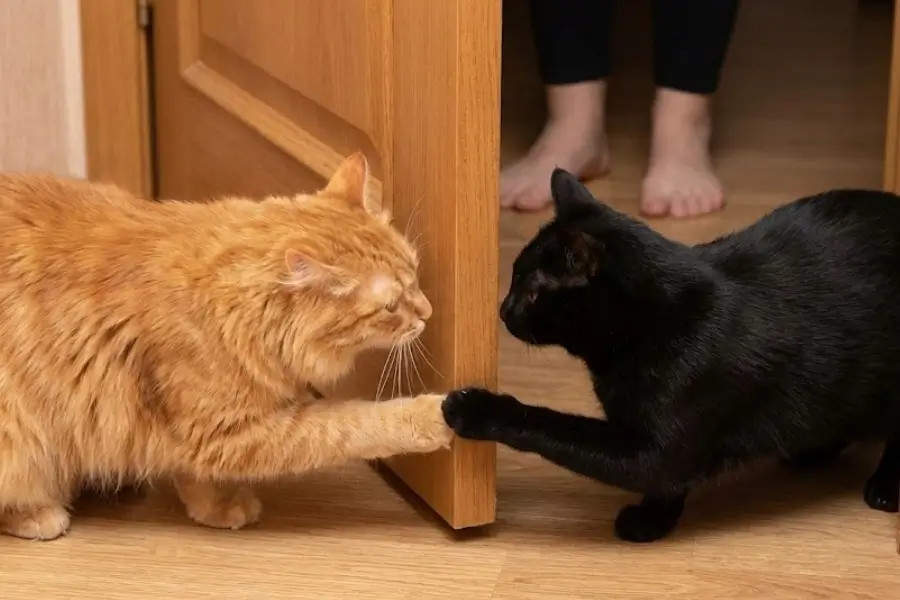
Cats are territorial, and the resident cat did not ask for a flatmate. Most failed introductions fail in the first hour, when two cats meet before either has any reason to tolerate the other.
Done slowly it usually works. The process is built around scent, because scent is how cats decide what belongs.
Start them completely apart
- Set up a safe room before the new cat arrives. A spare bedroom or a large bathroom with food, water, a litter tray, a bed and somewhere to hide.
- The new cat goes straight in there. It gives them somewhere to recover from the journey without immediately meeting a hostile resident.
- Keep them fully separate for at least seven to ten days, with the resident cat having no access to that room.
It feels unkind and it is the foundation everything else rests on. A new cat that has had time to settle meets the resident as a confident animal rather than a frightened one.
Swap scent before anything else
- Move bedding between them. A blanket the new cat has slept on goes into the resident’s space, and vice versa.
- When either investigates the new smell, give a treat or praise. You are making the other cat’s scent predict good things rather than an intrusion.
- Then swap rooms for short periods, each cat exploring the other’s territory while the other is safely shut away. This spreads the scent properly and lets each build a picture of the other without any risk.
Add sight, with a barrier
- Feed them on opposite sides of the closed door, and move the bowls a little closer at each meal. Eating is a vulnerable activity, so a cat that eats calmly near another cat is telling you something real.
- When that is settled, use a tall baby gate or a screen so they can see and smell each other without contact. Keep the first sessions short and end them while everyone is calm.
Then let them meet
Only when both are relaxed through the barrier. No hissing, no growling, and no long hard staring, which is the one people miss because it looks like nothing is happening.
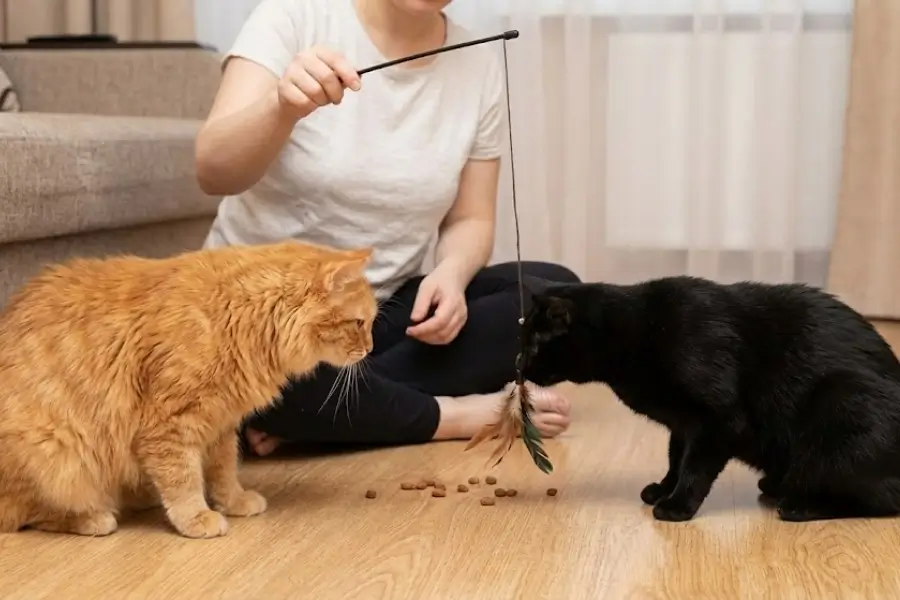
- Short supervised meetings in a neutral room, with treats and toys to hand. A wand toy is useful, because playing near each other is easier than simply being near each other.
- Finish before either cat gets tense. The session should end on a good note, not be ended by a fight.
- Lengthen them gradually over days or weeks.
What to expect
Weeks, and sometimes months. Kittens generally settle fast, two adult cats can take a long time, and some pairs never become friends and simply learn to share a house politely. That is a perfectly good outcome.
Make sure there are enough resources regardless of how well it goes: separate food bowls in separate places, litter trays equal to the number of cats plus one, and plenty of high places. A great deal of what looks like a personality clash is two cats competing for one good spot.
If there is real fighting with injuries, or one cat stops eating or using the tray, go back several steps and talk to your vet or a behaviourist rather than pushing on.












0 Comments