

Rats and mice tame well, and both are easily frightened by handling done in the wrong order. Getting it right is mostly about patience in the first fortnight.
Leave them alone first
Give a new animal at least 24 to 48 hours before you try to touch it. Keep the room quiet and let them work out where everything is.
Use the time. Sit by the cage and talk quietly so your voice becomes ordinary, and pass a treat through the bars now and then. You are aiming for a point where your arrival is interesting rather than alarming, and that happens on its own if you do not rush it.
Read what they are telling you
- Relaxed and curious. Coming to the door, ears forward, whiskers going, often standing up on the back legs for a better look. This one is ready.
- Frightened. Freezing, hiding, or flattening against the floor with ears pinned back and eyes bulging. Back off and try later. Forcing an interaction here costs you a week.
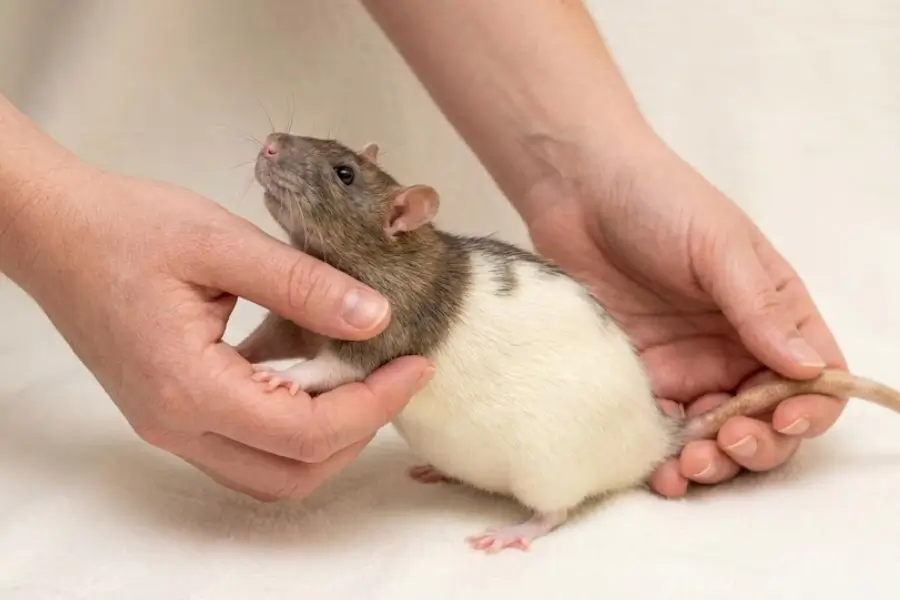
Picking up a rat
Rats are sturdier than mice and generally easier. The one absolute rule is never to lift a rat by the tail. It is painful and it can deglove, which means the skin strips off it entirely.
The scoop is the standard method:
- Slide one hand under the chest, just behind the front legs.
- Bring the other hand under the back end and tail so the whole animal is supported.
- Hold them against your chest. Contact with something solid is what makes a rat feel secure.
Once a rat is comfortable being carried, many will happily walk up onto a shoulder and stay there. Move slowly while they are up there and know where they are, because rats misjudge edges.
Picking up a mouse
Mice are smaller, quicker and more fragile, so there is less margin. Never lift by the tip of the tail. You can steady one briefly by the very base of the tail, right against the body, but only while your other hand goes underneath to take the weight.
Cupping:
- Lay one hand flat on the cage floor, palm up.
- Guide the mouse onto it with the other hand.
- Cup the second hand loosely over the top so they cannot leap off.
The tube method, which is better for a fast or timid mouse:
- Put a cardboard tube or small box in the cage.
- Wait for them to go in, which they will.
- Cover both ends with your hands and lift it out, then let them walk out onto your hand or into a play area.
This one is worth learning early. Chasing a mouse around a cage teaches it that hands mean being chased, which is the opposite of what you are trying to build.
Building the bond
- Hand-feed. Small high-value treats from your fingers, a bit of plain cooked chicken, a sunflower seed, a dab of yoghurt. The most effective single thing you can do, because it makes hands the source of good things.
- Free roam time. A safe escape-proof area where you can sit while they explore and climb over you. Getting used to your scent while nothing is being asked of them does a great deal.
- Grooming. Many rats enjoy being stroked or worked over gently with a soft toothbrush, which imitates the social grooming they do with each other.
The general rule
Let the animal set the pace and finish every session while it is still going well. Stopping one minute early is always better than stopping one minute late.
Both species are social and neither should be kept alone, so do this with a pair. Two settled rats that trust you are far better company than one anxious one.












0 Comments