
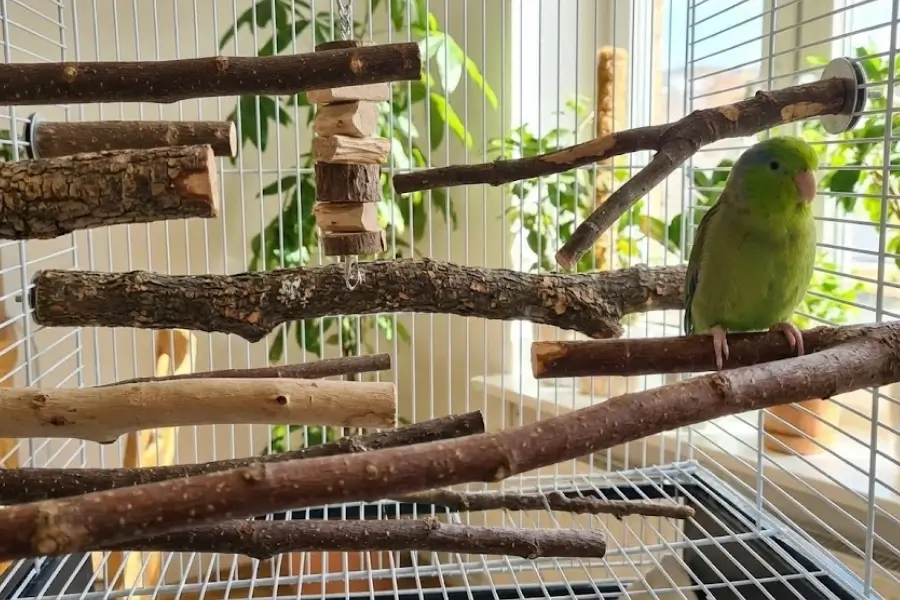
Natural branches do several things a dowel perch cannot. Varied diameters work the foot, rough bark keeps nails down, and stripping it gives a beak something legitimate to destroy.
The catch is that some very ordinary garden trees are toxic to birds, and a few are seriously so. Here is what is safe, what is not, and how to prepare a branch before it goes in the cage.
Why it is worth bothering
Wild birds spend their lives on branches of every thickness, gripping uneven surfaces that keep the foot muscles and joints working. A cage of identical smooth dowels puts pressure on the same points of the foot all day, which is how bumblefoot starts.
The mental side matters as much. Stripping bark and working out how to get around an awkward shape occupies a bird, and an occupied bird is far less likely to start plucking.
Safe woods
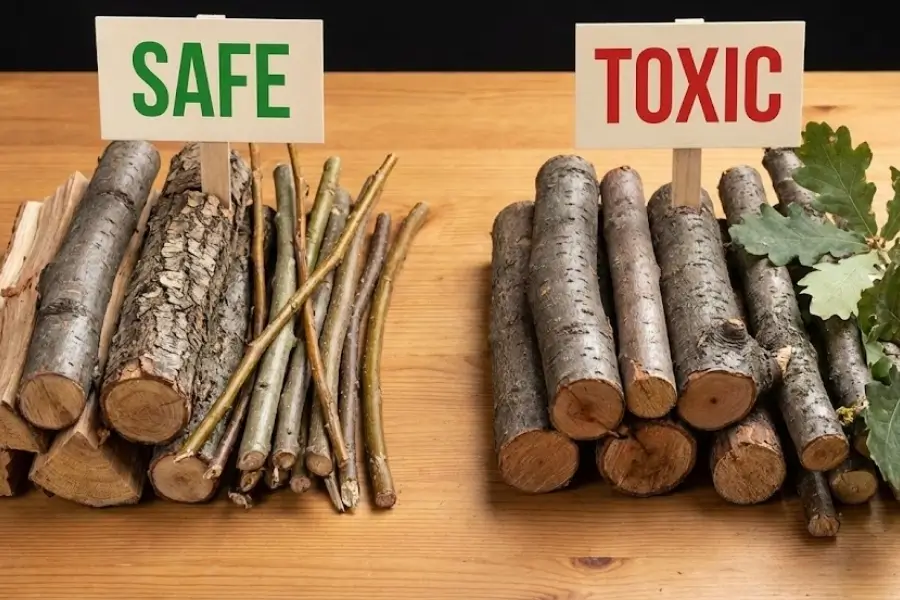
All of these are fine to perch on and chew, provided they have had nothing sprayed on them.
- Apple, crabapple and pear. Hard, durable, and popular with most birds.
- Ash, elm, dogwood and hazelnut. Hard woods that stand up to chewing.
- Aspen, cottonwood and poplar. Softer, better suited to smaller birds.
- Manzanita and ribbonwood. Extremely hard and long lasting, which is why they are the usual choice for permanent perches.
- Bamboo, which is a grass, and useful for texture.
- Birch, though the bark of some species is high in oils.
- Willow, a firm favourite for chewing.
- Magnolia, hawthorn with the thorns taken off, and larch.
- Maple, but not red maple.
- Eucalyptus, safe for Australian species and worth more caution with others.
- Pine and fir, only once dried and cured so the sticky resin is gone.
Toxic woods
Several of these are common garden plants, and a few are dangerous in very small amounts. The stone fruits are the ones people get caught by, because the fruit is harmless and the wood is not.
- Apricot, cherry, peach, plum and nectarine. All contain cyanogenic glycosides.
- Azalea and rhododendron. Every part of the plant is highly toxic.
- Yew and oleander. Highly toxic throughout. Do not have either anywhere near a bird.
- Black locust, bark and leaves.
- Black walnut, which contains juglone.
- Boxwood, leaves and twigs.
- Cedar, whose aromatic oils irritate the respiratory system.
- Elderberry, bark, leaves and roots.
- Holly, berries and leaves.
- Horse chestnut, which contains aesculin.
- Hydrangea, also cyanogenic.
- Juniper, some species.
- Oak, from the tannin levels in bark and leaves.
- Red maple, which can cause haemolytic anaemia.
- Redwood, whose dust irritates the airways.
Preparing a branch
- Look it over for mould, fungus or a heavy insect population, and reject anything doubtful.
- Scrub with a stiff brush and a mild washing-up liquid to get dirt and droppings off.
- Rinse until there is no trace of soap left.
- Disinfect. Bake at around 200 degrees Fahrenheit for 45 to 60 minutes, or dry in full sun for several days, or use one part bleach to ten parts water followed by very thorough rinsing and drying.
- Check it over once more for splinters and sharp points before it goes in.
The one rule that covers everything
If you cannot identify the tree with certainty, do not use it. The list of safe woods is long enough that there is no reason to gamble on an unknown branch.
The same goes for provenance. A perfect apple branch from a roadside or a sprayed orchard is not a safe branch, and nothing about the wood will tell you which one you have.












0 Comments