
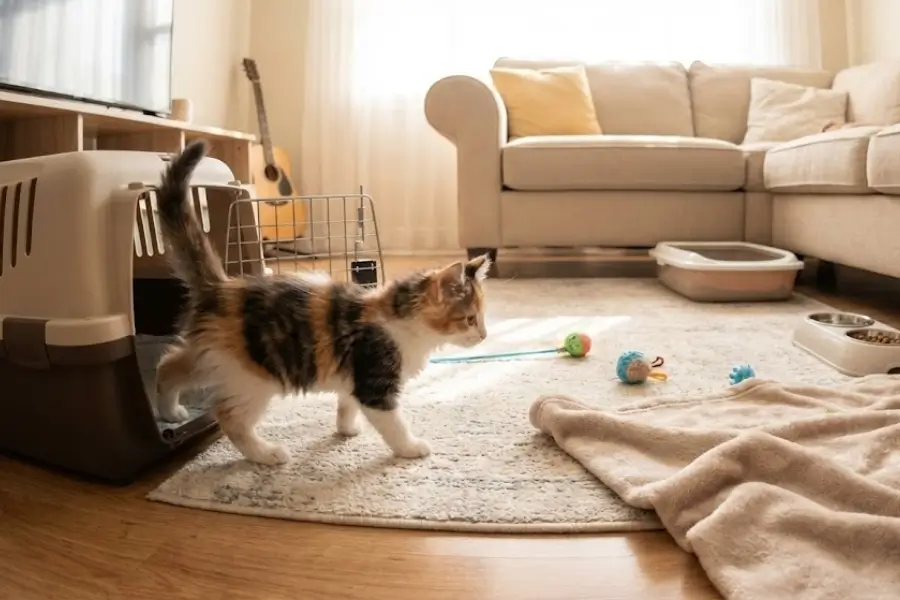
A kitten arriving has just lost everything it knew: its mother, its siblings, the room it was born in, and every smell it recognised. The excitement is entirely on your side of the transaction.
Give the first week over to making the world small and predictable, and almost everything else goes more easily.
Before they arrive
- Set up a safe room. A spare bedroom or bathroom, quiet and out of the way. This is the whole world for the first few days, and a small world is a manageable one.
- Put everything in it: litter tray, food and water, a bed, a scratching post and a couple of toys. Keep the tray well away from the food.
- Kitten-proof properly. Kittens fit into gaps you would not believe, so block off the backs of appliances and under furniture. Deal with cables, toxic houseplants and anything small enough to swallow. Hair ties and thread are the classic ones.
The first day or two
- Open the carrier and leave it open. Let them come out when they decide to, which may be an hour. Sit on the floor and do something else.
- Keep it quiet. Soft voices, no sudden movements, and resist inviting everyone round to see the kitten.
- Start the routine immediately. Same feeding times, same play times, tray cleaned at the same points in the day. Predictability settles a kitten faster than attention does.
Meeting the other pets
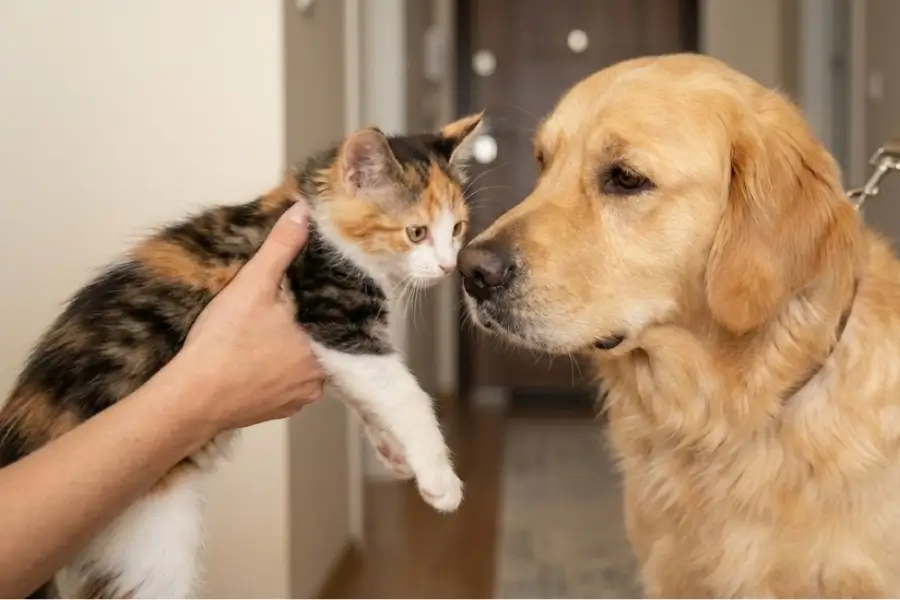
Slower than you think, and worth it. A fortnight of care prevents a relationship that never recovers.
- Swap bedding between the safe room and the rest of the house so everyone learns the new smell before they meet it.
- Then let them see each other through a baby gate or a cracked door, without any chance of contact.
- Short supervised meetings once both are calm through the barrier, with treats on hand for everyone.
- Extend the time gradually, always supervised, and make sure the older animal has somewhere high to retreat to. Most trouble comes from a resident cat with nowhere to get away from an enthusiastic kitten.
Meeting the family
- Show children how to stroke gently, and explain that a kitten who walks away is finished rather than being unfriendly.
- Never leave a young child alone with a kitten. Kittens are fragile and children are not deliberately rough.
- Have children sit on the floor and let the kitten come to them. A kitten who chose to approach stays much longer than one who was picked up.
The thing worth doing this week specifically
Kittens have a socialisation window that closes at around twelve to fourteen weeks. What they meet calmly in that period they tend to accept for life.
So while they are settling, quietly introduce the ordinary things: the vacuum, the doorbell, being handled around the paws and ears, the carrier left open in the room, gentle brushing. A few minutes a day now saves years of difficulty at the vet.












0 Comments