

It is worth saying the important thing first: the cat is not doing this to get back at you. Cats do not work that way, and starting from spite sends you looking in the wrong place entirely.
Peeing outside the box is one of the commonest reasons cats are given up to shelters, and it is also one of the more solvable problems, provided you work through it in the right order.
Start at the vet, always
Do not try to fix the behaviour until a vet has ruled out a medical cause. Cats conceal pain thoroughly, and going outside the box is very often the only visible sign that something is wrong.
- Urinary tract infection. It hurts to urinate, the cat associates the pain with the box, and it starts looking for somewhere that might not hurt.
- Feline lower urinary tract disease, covering bladder stones, crystals and cystitis. In male cats a blockage is an emergency.
- Kidney disease, which brings more thirst and more urine than the box was set up for.
- Diabetes, for the same reason.
- Arthritis. Nothing wrong with the bladder at all, just a box with sides too high to climb into without it hurting.
A urinalysis is quick and rules most of this out. It is the right first step even when you are fairly sure the cause is behavioural.
Behavioural causes
With a clean bill of health, there are three broad explanations.
- Stress. Cats run on routine and notice changes we think are minor. A move, building work, a new baby, a new pet, or ongoing friction with another cat in the house.
- Dislike of the box itself. Not clean enough, wrong litter, wrong shape, or in a spot that feels exposed or hard to escape from.
- Marking, which is a different behaviour. Spraying goes on vertical surfaces in small amounts and is usually about territory, often triggered by a cat outside the window.
Fixing it
Never punish a cat for this. It adds stress to a problem stress is very often causing, and it teaches the cat to avoid you rather than to use the tray.
Get the boxes right
One box per cat plus one spare. It sounds excessive and it prevents both resource guarding and the situation where the only box is dirty at the wrong moment.
- Scoop every box at least daily.
- Empty, wash with mild soap and warm water and refill every one to four weeks.
- Clean accidents with an enzymatic pet cleaner that breaks down uric acid. Never use anything ammonia-based, because to a cat ammonia smells like urine and marks the spot as a toilet.
Reduce the stress
- Work out what changed and whether any of it can be undone or softened.
- Synthetic feline pheromone diffusers help some cats and are worth trying.
- Make sure there are high places to retreat to, especially in a multi-cat house.
- Keep them occupied with interactive play and proper scratching posts.
Make the box more appealing
- Put two or three boxes side by side with different litters in them and see which gets used. Cats have strong preferences and will tell you clearly.
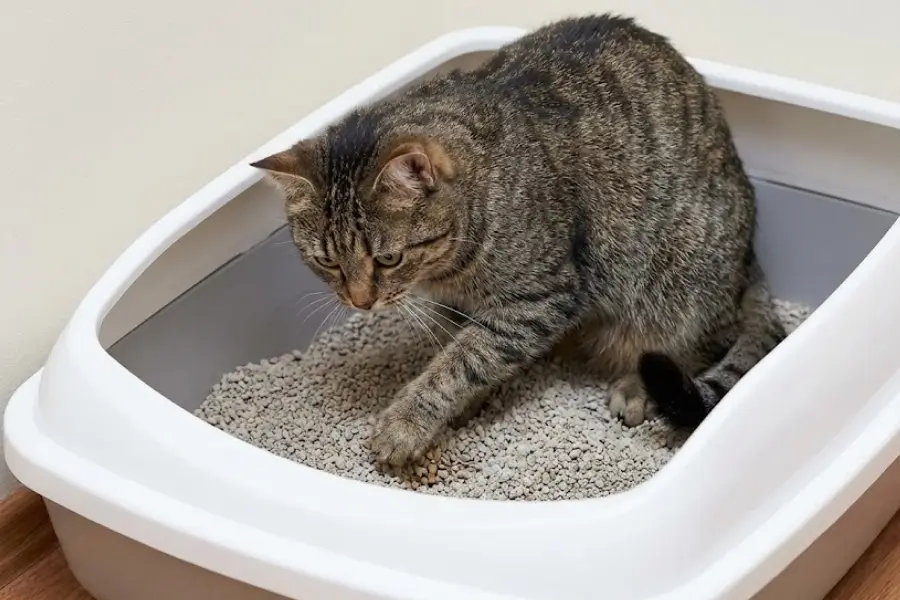
- Try a large uncovered box. Hoods keep smell in for you and trap it for the cat, and they remove the escape route a nervous cat wants.
- For an older cat, find one with a low entry or cut a section down. This one fix solves a surprising number of cases.
The way to think about it
Work through it as a sequence rather than a guess: vet first, then the box, then the stress. Most cases resolve at one of those three, and the ones that do not are usually a combination.
It takes weeks rather than days, and it is genuinely worth the patience. The cat is not being difficult. It is reporting a problem in the only way available to it.












0 Comments